

Lake States Lumber Association Education Workshop Equips Industrial Arts Teachers to Guide Students into Wood Technology Careers
Wisconsin high school industrial arts and wood technology teachers converged in Antigo on June 24-25 for a professional development workshop focused on the state’s primary and secondary wood products industry. The immersive two-day program was a collaborative effort aimed at strengthening the link between education and industry, with the ultimate goal of equipping educators to better steer students interested in skilled careers and training opportunities, including Northcentral Technical College’s (NTC) Wood Science Program.
The Lake States Lumber Association Education, Inc. partnered with NTC, Wisconsin DNR Forest Products Services Team, and the University of Wisconsin Extension to host this first annual Wood Industry Teacher Camp. NTC Wood technology instructor, Logan Wells, organized the program stating, “I can’t thank our wood industry partners enough for supporting this program. Connecting with K-12 teachers is a first step in recruiting and training our future wood industry workforce.”
The workshop’s first day provided an intensive look at the initial stages of wood processing. The morning sessions were designed to build foundational knowledge, starting with a 30-minute introduction into log scaling and grading, which covered techniques for determining the volume, quality, and value of sawlogs taught by Professor Steve Hubbard, UW Extension. This was followed by a session on basics of hardwood lumber grading taught by Tim Kassis, Kretz Lumber Company, retired.
Teachers then transitioned to NTC’s state-of-the-art training sawmill for a series of hands-on rotations. The sawmill rotations offered a unique, up-close look at the journey of a log from its raw state to finished lumber. Teachers spent time at six different stations. They observed and operated the critical functions of the headsaw, which makes the initial cuts on the raw log; the edger, which squares the boards; and the resaw, which further processes the large square cants into lumber, pallet cants, or railroad ties. The rotations continued in the afternoon covering the pre-turner, which turns cants for optimal sawing, as well as the trimmer and the final piling and sorting of the finished lumber. Participants also saw and learned about the saw filing program at NTC. Wells stated, “This was a special opportunity to learn about our industry firsthand. Operating this equipment is a catalyst for these teachers to share the story of our industry with their students. The goal was to make an impact that will echo through these teachers’ entire careers, and there is no better way to do that than to sit in the seat, push the buttons, and breakdown a log on the headrig.”
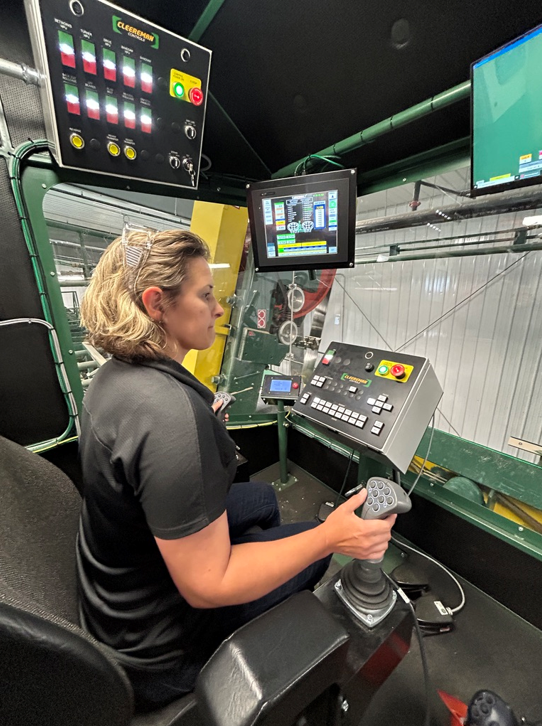
Participant operates the optimized headsaw.
The afternoon concluded with a classroom session explaining wood, water, and lumber drying taught by Professor Scott Bowe, UW Extension. Lumber must be dried to suitable moisture content to be used in indoor applications such as flooring and millwork. The group moved to the wood shop for a hands-on kiln setup. Here, teachers filled kilns and learned how to cut and weigh wood samples to monitor the drying process, a crucial step in preparing lumber for commercial use. The day’s formal activities were capped off with a networking dinner at City Park in Antigo, fostering connections and collaboration among the educators and industry professionals.
The second day shifted the focus from the hands-on process to classroom application and career pathways. The morning began with a discussion on how to apply the previous day’s lessons in the classroom, led by Gretchen Marshall, forestry educator at UW-Stevens Point. This was followed by presentations on key educational and career programs, including the UW-Stevens Point Wisconsin Forestry Center and LEAF programs, as well as an overview of NTC’s own Wood Technology Center of Excellence and the various woods educational programs. Teachers also received an overview of secondary manufacturing and lumber market sectors.
The second day’s hands-on activities took place in the wood shop, with teachers participating in three rotations. Each group observed shop demonstrations of rough and finish mills. They also learned to use moisture meters and weigh the wood samples prepared the previous day. Finally, they engaged in a breakout session focused on wood properties and wood identification, which also included a recap of potential careers in the industry. One of the participating teachers said, “We teach to our strengths, and if you don’t have experience and confidence in something, you’re not going to tell the students about it.”

Participant operates the horizontal resaw.
The capstone of the workshop was a field trip to Menzner Hardwoods in Marathon City, Wisconsin. Teachers enjoyed a firsthand look at a successful secondary manufacturing facility that produces high-end millwork. The tour provided a comprehensive look at how lumber from the primary mills is turned into finished goods at this secondary value adding mill. Menzner Hardwoods recently upgraded their facility with a state-of-the-art scanning and optimizing technology, yet another example of science and technology moving into a traditional manufacturing industry. Participants toured the kiln drying operations, millwork operations, and veneer wrapping operations.

Instructor, Mitch White, discusses saw filing and the saw filing program at NTC.
Participants received a stipend and travel expenses to attend. We would like to thank the Lake States Lumber Association Education, Inc. for financially supported this workshop and Menzer Hardwoods for providing their time and experience during the tour. Responses from the participants after the program were very positive and plans for the Second Annual Wood Industry Teacher Camp are in the works for August of 2026.
The workshop provided teachers with not only a behind-the-scenes look at the Wisconsin timber industry but also the resources and confidence to inspire the next generation of wood technology professionals. By bridging the gap between high school industrial arts programs and the needs of a vital state industry, the workshop represents a significant step in developing a robust workforce pipeline. Teachers left with new knowledge and connections, empowered to guide students toward the diverse and rewarding career paths available right here in Wisconsin.
This article was prepared by Scott Bowe, Professor of Wood Products, University of Wisconsin. To learn more about the program, contact Logan Wells at wells@ntc.edu or (715) 348-7794.